Schema Is Not Your AI Visibility Strategy
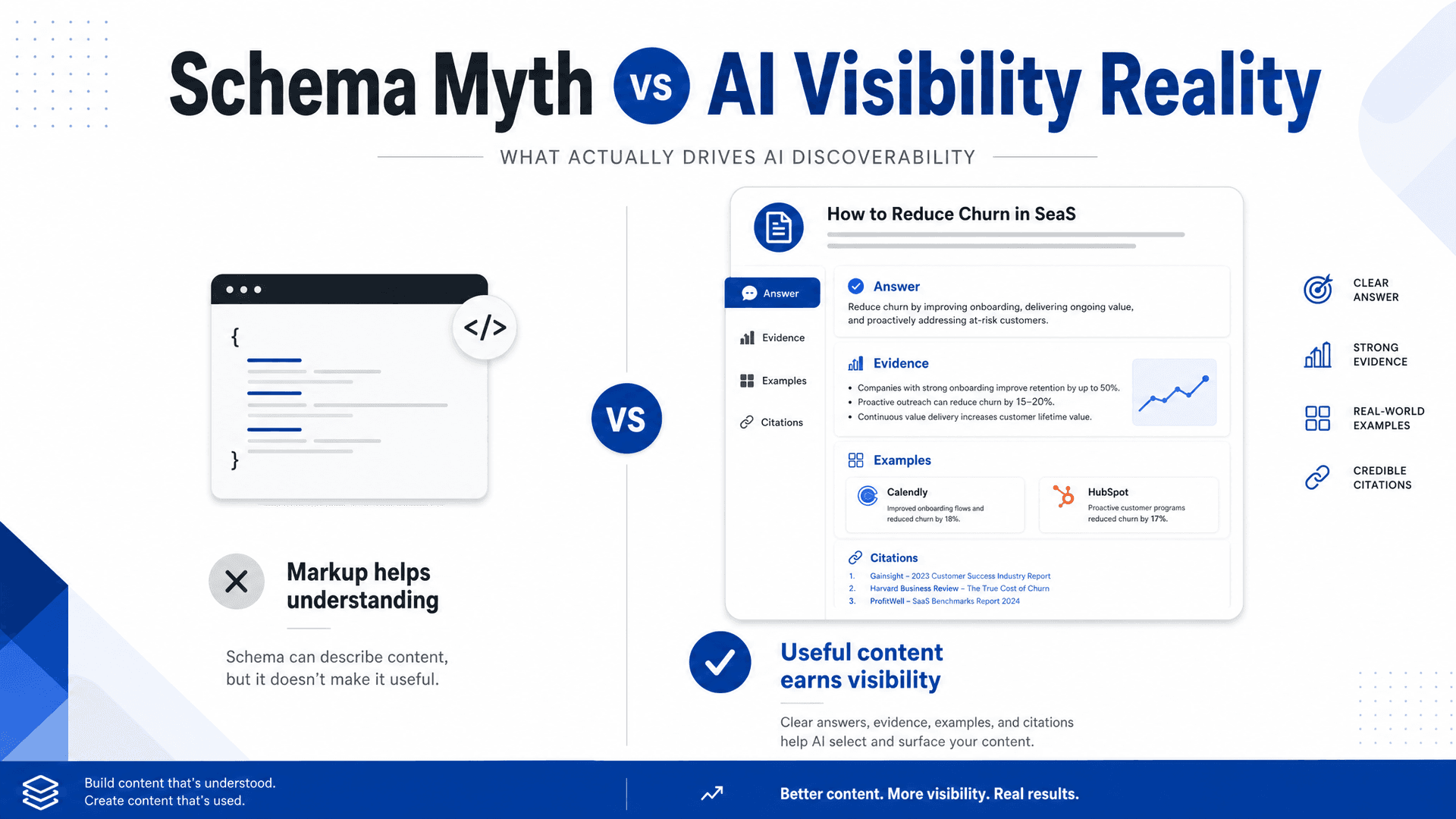
If you want better visibility in AI search, schema alone will not get you there. The real gains come from useful content, clear structure, strong evidence, and pages that answer real questions better than the alternatives.

Tobias Holmgren
Practical AI agents, automation workflows, and reviewed business systems.
Published May 13, 2026
There is a lazy pattern in digital marketing: someone spots a correlation, turns it into a tactic, and suddenly everybody acts like it is a shortcut.
Right now, one of the biggest examples is schema markup and AI visibility.
Yes, pages that get cited by AI systems often have schema. But that does not automatically mean schema is the reason they get cited.
That distinction matters, because a lot of teams are about to waste time chasing a technical checkbox instead of fixing the real problem: their content is not structured, useful, or evidence-rich enough to deserve visibility.
What people are getting wrong
Schema markup is useful. It helps search engines understand page elements more clearly. It can support rich results. It can improve content organization at the machine-readable level.
But schema is not the same thing as a visibility strategy.
A recent Ahrefs study tracked 1,885 pages that added JSON-LD schema and compared them against control pages. The result was simple: AI citations barely moved. In other words, adding schema by itself did not create a meaningful uplift across the measured AI surfaces.
That should not be surprising. Better-maintained sites are more likely to use schema, but they are also more likely to have stronger content, clearer topical authority, better internal linking, fresher updates, and more useful pages overall. Schema may be present on good pages without being the thing that made those pages valuable.
Why this matters for business
If you run marketing, SEO, or content for a business, this is actually good news.
It means AI visibility is not locked behind some obscure markup trick. You do not need a secret GEO hack. You need pages that are genuinely easier for both humans and machines to understand and trust.
That changes the conversation from technical superstition to practical execution:
Are we answering the real question clearly?
Are we giving a direct answer early on the page?
Are we supporting claims with examples, proof, and specifics?
Is the page structured well enough for a retrieval system to extract useful pieces?
Does this page deserve to be cited over the alternatives?
That is a much healthier strategy than hoping a schema plugin will do the work for you.
What likely matters more than schema
Google's own guidance around AI experiences keeps pointing in the same direction: focus on original, satisfying, people-first content. Not tricks. Not gimmicks. Not formatting for its own sake.
From a practical point of view, the pages most likely to perform well in AI-driven search and citation systems tend to do a few things well:
1. They answer the core question fast
If a page takes 800 words to say something simple, it becomes harder to extract useful value from it. Strong pages often give a clear answer near the top, then expand with context and detail.
2. They use clean, predictable structure
Question-based headings, descriptive subheadings, short sections, bullets, and clear transitions make pages easier to scan, summarize, and cite.
3. They include real evidence
Original examples, numbers, source references, screenshots, process details, and lived experience all make content more trustworthy. AI systems are far more useful when they can pull from pages that say something concrete.
4. They show topical depth
One isolated article rarely builds much authority. A cluster of useful pages around a topic sends a stronger signal that your site knows what it is talking about.
5. They stay updated
Stale pages lose value. In fast-moving categories like AI, search, and automation, freshness matters because yesterday's advice quickly turns into noise.
A simple example
Imagine two agencies both want to rank and get cited for a topic like AI lead qualification workflows.
Agency A adds schema markup to an average article. The article is vague, padded, and full of generic advice like "use automation to save time."
Agency B publishes a tighter page with:
a plain-language definition at the top
a short workflow example
a breakdown of tools involved
a caveat about bad CRM data
a section on how to start with one step first
specific evidence from implementation experience
Even if both pages use schema, Agency B is much more likely to be worth citing because it is more useful. The markup may help understanding around the edges, but the substance is doing the heavy lifting.
The common mistake
The biggest mistake is treating AI visibility like old-school SEO shortcuts.
People hear a new term like GEO, AEO, or AI citations and immediately ask for a lever they can pull without improving the actual page. That instinct is understandable, but it is usually wrong.
AI retrieval and summarization systems still depend on content quality. If your page is unclear, thin, repetitive, or non-specific, technical markup will not rescue it.
Schema is still worth implementing where it makes sense. It is just not the strategy.
How to start small
If you want to improve your visibility in AI search without wasting effort, start here:
Pick one high-intent page. Choose a page tied to a real business question or buying journey.
Rewrite the opening. Add a direct answer in the first few paragraphs.
Improve structure. Use question-led headings, concise sections, and scannable formatting.
Add specifics. Include examples, proof points, steps, tradeoffs, or source-backed claims.
Review schema last. Make sure your markup is clean and accurate, but treat it as support work, not the main growth bet.
That sequence is much more likely to create useful gains than leading with markup.
The takeaway
Schema is helpful infrastructure. It is not your AI visibility strategy.
If you want stronger performance in AI search, citations, and retrieval systems, focus on what should have mattered all along: useful content, clearer structure, stronger evidence, and pages built to solve real questions better than competitors do.
That may be less exciting than a magic GEO trick, but it is a far better way to build durable visibility.